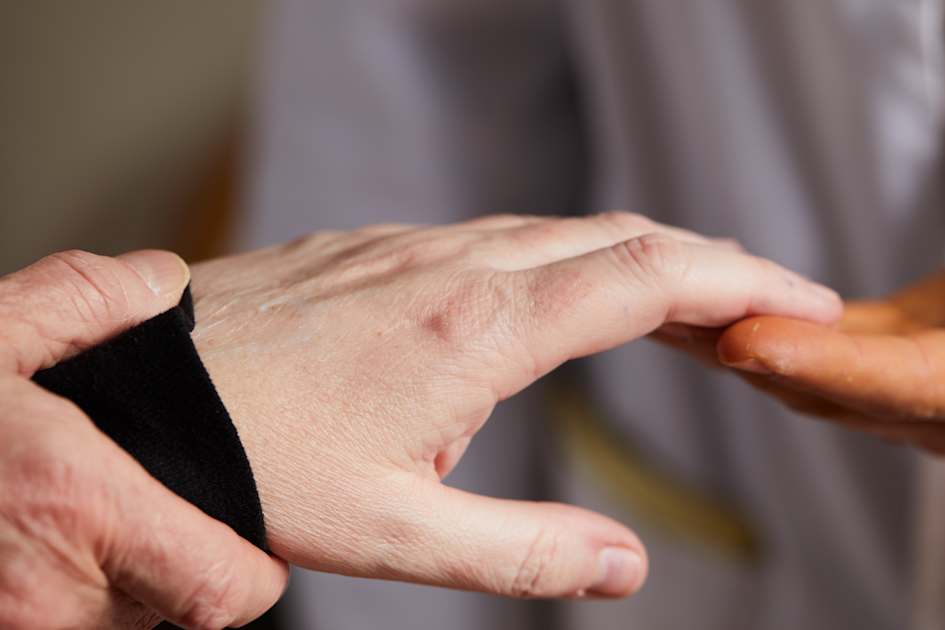
Yale School of Medicine is taking a prominent role in a new national research consortium targeting epidermal differentiation disorders, a group of rare inherited skin diseases known as ichthyoses and palmoplantar keratodermas. The Consortium for Hereditary Epidermal Differentiation Disorders (CHEDD) is co-led by Northwestern University Feinberg School of Medicine and has received a five-year, $5 million grant from the National Institute of Arthritis and Musculoskeletal and Skin Diseases, part of the National Institutes of Health (NIH).
Read More
Keith A. Choate, MD, PhD, chair and Aaron B. and Marguerite Lerner Professor of Dermatology at Yale, and Amy S. Paller, MD, chair and Walter J. Hamlin Professor of Dermatology at Northwestern, are spearheading the initiative. CHEDD combines efforts from seven clinical sites and patient advocacy organizations to investigate these disorders on a level that would be unattainable by individual centers alone.
Choate stated that families dealing with these conditions face critical questions about the long-term implications and effective treatments for their children. By uniting genetic diagnosis, thorough long-term examinations, and advanced molecular tools across multiple institutions, CHEDD aims to better understand the diseases and connect patients to appropriate therapies.
The NIH Rare Diseases Clinical Research Network (RDCRN) supports this collaboration, which involves partnerships between researchers, patients, and advocacy groups. Notable advocacy organizations participating in CHEDD include the Foundation for Ichthyosis & Related Skin Types and the Pachyonychia Congenita Project, which play a vital role in shaping research questions and connecting patients to clinical studies.
Recent international consensus classifications have defined epidermal differentiation disorders as a broad category of genetic skin conditions caused by mutations in various skin barrier-related genes. Symptoms include skin thickening, scaling, and redness.
Janice Schwartz, president and CEO of the Pachyonychia Congenita Project, emphasized that the consortium presents an opportunity for enhanced collaboration, ultimately aiming for improved treatments for patients.
CHEDD's research is structured into three primary projects: 1) a longitudinal registry to track the progression of each disorder subtype and identify outcomes for future clinical trials; 2) a clinical trial assessing the efficacy of erlotinib, an oral medication targeting overactive growth signals in the skin (ClinicalTrials.gov NCT06545695); and 3) comprehensive analyses to uncover molecular changes related to each disorder and find biomarkers for activity and treatment response.
In addition to its research arms, the consortium encompasses an administrative core, a pilot-feasibility core to fund emerging studies, and a training program for early-career researchers. Data and biospecimens from CHEDD will be accessible to the larger research community through RDCRN and NIH data repositories.
Paller remarked on the necessity for individuals with epidermal differentiation disorders to receive the same level of evidence-based care that is expected for more prevalent diseases. The consortium will facilitate essential studies and trials, actively involving the patient community in the process.
Participating clinical sites in addition to Yale and Northwestern include Stanford University, the University of California San Diego, Rady Children’s Hospital, the University of Colorado, the Medical University of South Carolina, and the University of Texas at Austin's Dell Children's Medical Center.
Research supported by the National Institute of Arthritis and Musculoskeletal and Skin Diseases of the NIH under Award Number U54AR089183 reflects the authors' independent work and does not necessarily express official NIH views.