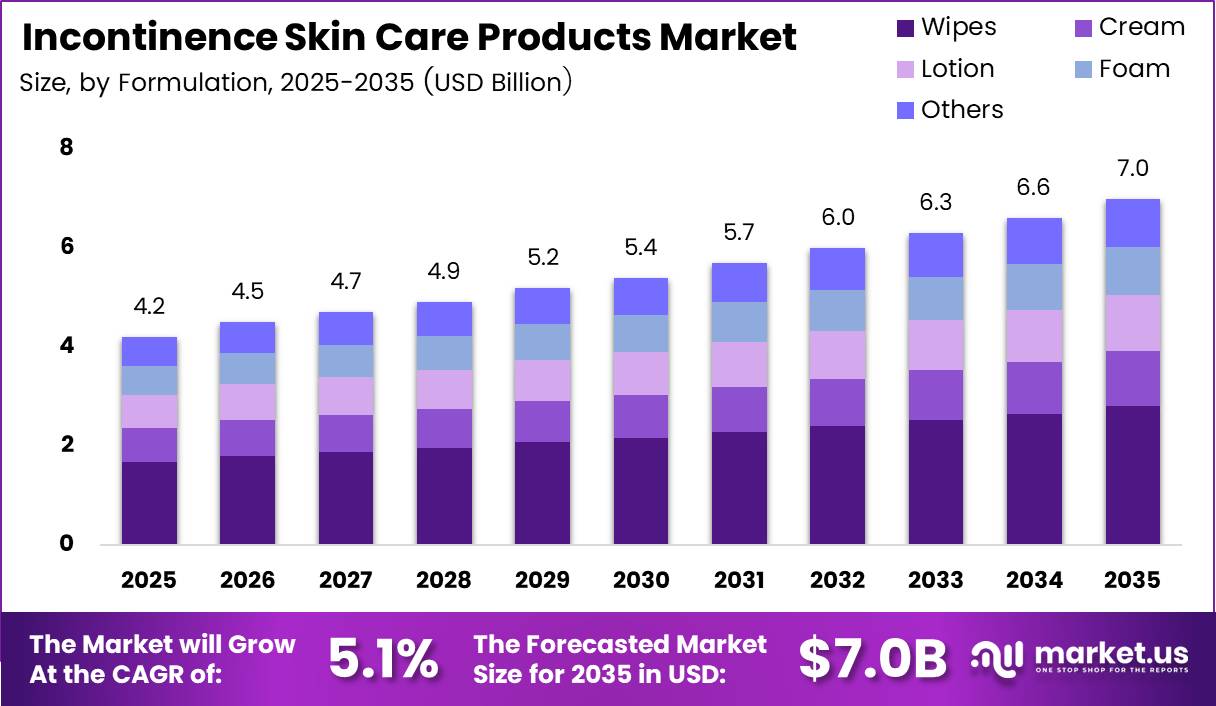
The Global Incontinence Skin Care Products Market is anticipated to grow from USD 4.2 Billion in 2025 to approximately USD 7.0 Billion by 2035, representing a compound annual growth rate (CAGR) of 5.1% during the period from 2026 to 2035.
Read More
This market encompasses various products, including cleansers, wipes, barrier creams, repair creams, moisturizers, body washes, gels, and other topical formulations aimed at maintaining skin integrity for individuals dealing with incontinence. These products are utilized across hospitals, long-term care facilities, and home care for people of all ages and genders.
Key insights from the report indicate that cleansing and deodorizing wipes will lead the market with a 24.00% share in 2025, largely due to their efficiency in institutional settings. Wipes, in particular, represent 39.00% of the market by formulation, favored for their ease of use in environments with staffing challenges. Packaging-wise, bottles dominate with a 22.00% share, attributed to their adaptability for different product consistencies.
In terms of pricing, mid-range products hold a leading position at 49.00% as institutional buyers prefer clinically adequate options at reasonable costs. Women account for the largest end-user segment, with a 56.00% share, largely due to the higher prevalence of incontinence in females. Pharmacies and drugstores are the primary distribution channels, capturing 29.00% of the market, significantly influenced by their advisory roles in product selection for caregivers.
North America leads the market with a 36.00% share, valued at USD 1.51 Billion in 2025, backed by established skin-care protocols in various care settings. The report notes a trend toward structured prevention systems in procurement, as regulations tighten around hospital-acquired conditions and skin integrity protocols. This shift is facilitating the adoption of bundled care solutions that include cleansing and barrier protection.
Research highlights the effectiveness of foam cleansers, with a 2025 Cochrane review indicating a 65% lower risk of incontinence-associated dermatitis compared to traditional soap and water. This evidence supports the transition to pH-balanced cleansers within formularies.
The market dynamics also reflect the challenges of affordability as caregivers often substitute clinical products with more economical options, slowing down premium product penetration, especially in emerging markets. Nonetheless, there is substantial opportunity for growth through protocol-led care bundles and subscription replenishments in home care.
Key players in this sector include Coloplast A/S, Essity AB, and Kimberly-Clark Corporation among others, all of which are navigating competitive landscapes shaped by regulatory requirements and evolving consumer needs.