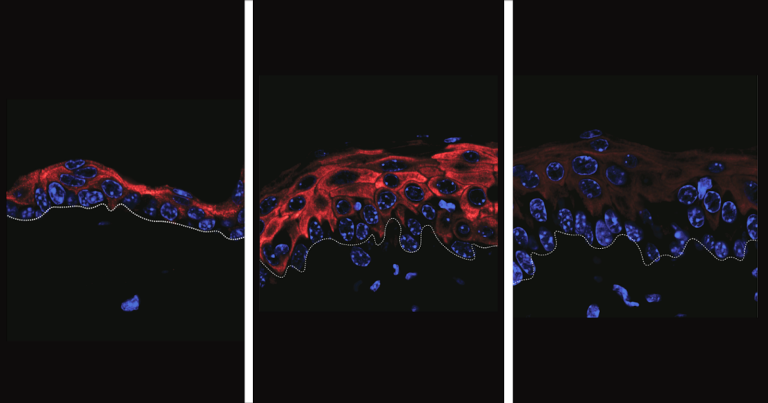
Researchers at Stanford Medicine have discovered that two proteins with opposing roles are essential for the development and maintenance of healthy skin. They propose that altering the activity of these proteins using topical medications could help reduce inflammation, promote wound healing, and potentially inhibit the growth of skin cancer.
Read More
The proteins are classified as ubiquitin-like proteins, which play a significant role in the regulation of protein lifecycle in cells. In skin tissues, these proteins modulate gene activity related to cellular growth and differentiation by influencing progenitor, or stem, cells within the skin's lower layer. These progenitor cells can either mature into specialized keratinocytes that form the skin barrier or self-renew.
Paul Khavari, MD, PhD, who leads the Department of Dermatology at Stanford and is the study's senior author, noted the unique function of these proteins. He stated that one protein promotes the stem-cell state while the other encourages differentiation, acting as opposing forces that influence cellular fate. The study was published in Science on June 25, with contributions from lead authors Mårten Winge, MD, PhD, and MD/PhD student Leandra Jackrazi.
Winge highlighted that manipulating these systems yields distinct and predictable outcomes, making them valuable targets for therapeutic development.
The research delineates the skin's outer layer into two functional areas: the lower level containing progenitor cells, which serve as a reservoir of stem cells waiting to differentiate into keratinocytes. These keratinocytes are vital for maintaining skin hydration, protecting against pathogens, and shielding against UV radiation.
Progenitor cells maintain their population through limited division but can differentiate and migrate to the skin’s surface in response to injury, infection, or routine shedding. An imbalance in this process can lead to conditions like psoriasis, impaired wound healing, or skin cancer.
To explore the differentiation process, the researchers conducted extensive experiments on the genetic expression of keratinocytes. They observed that differentiating cells exhibited increased activation of genes related to skin development while showing diminished activity in genes responsible for maintaining stem cell properties.
Further investigation revealed that disrupting over 200 genes in the ubiquitin pathway unveiled two critical subpathways essential for differentiation: NEDDylation and SUMOylation. Inhibition of the NEDDylation pathway accelerated differentiation, while blocking SUMOylation inhibited it. These findings were corroborated through pharmacological blockage of these pathways in human keratinocytes and skin organoids.
The team engineered laboratory mice to allow for the conditional suppression of two key proteins—Nedd8 and Sumo2—associated with the NEDDylation and SUMOylation pathways. The results showed abnormal skin development when the expression of either protein was impeded, leading to conditions reminiscent of psoriasis in Nedd8-deficient mice, while mice lacking Sumo2 experienced differentiation issues and structural skin abnormalities.
Moreover, the loss of Nedd8 and Sumo2 altered the immune cell composition within the skin. Nedd8 deficiency resulted in increased neutrophil presence and inflammation, while Sumo2 deficiency led to T cell proliferation.
Khavari emphasized that the findings impact the entire tissue microenvironment rather than just individual cells, suggesting that targeting these pathways could be beneficial in treating skin wounds, inflammation, aging, and cancer.
Further analysis indicated that Nedd8 affects cell differentiation by interacting with the RNA-binding protein HNRNPU. In the absence of Nedd8, HNRNPU stabilizes RNA for genes required for differentiation, while its presence promotes maintenance of progenitor cells.
The research team is investigating the potential of topical treatments that target the NEDDylation or SUMOylation pathways to influence keratinocyte differentiation and maintenance, which could lead to new therapies for various skin disorders.
Jackrazi noted the significance of these findings across multiple disease states, presenting new opportunities for interventions in wound healing, inflammation, and cancer management.
The study was supported by the National Institutes of Health and the U.S. Department of Veterans Affairs Office of Research and Development.