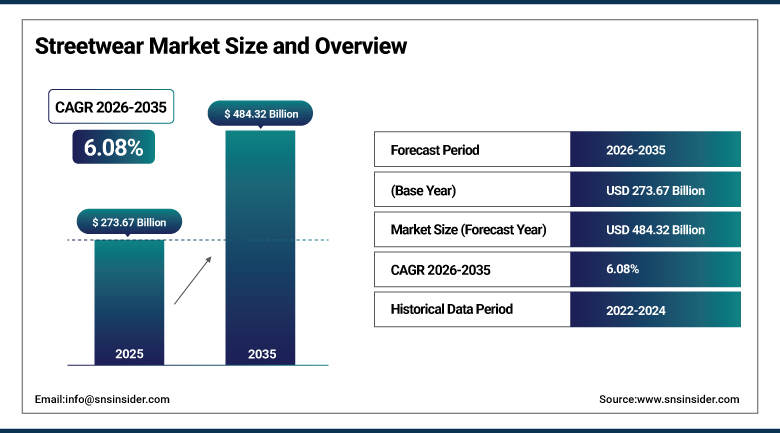
The Streetwear Market was valued at USD 273.67 billion in 2025 and is expected to reach approximately USD 484.32 billion by 2035, representing a compound annual growth rate (CAGR) of 6.08% from 2026 to 2035.
Read More
This consistent growth in the streetwear sector is driven by the increasing significance of fashion culture among young consumers, social media trends, and the merging of sportswear, luxury wear, and casual wear. The influence of Gen Z and Gen Alpha is particularly impactful, as these demographics drive interest in limited releases, sneakers, and fashion led by influencers. Additionally, the expansion of e-commerce and direct-to-consumer (D2C) streetwear brands is further propelling market dynamics.
Major brands like Nike and its subsidiary Converse are expanding their collaborations with global artists and designers, while Adidas is enhancing its strategy by introducing new streetwear lines independent of Yeezy and forming partnerships in sports-luxury. LVMH brands such as Louis Vuitton and Off-White are also enhancing the luxury-streetwear convergence through limited capsule collections and digital marketing campaigns.
In the U.S., the Streetwear Market is projected to grow from USD 75.93 billion in 2025 to around USD 128.24 billion by 2035, achieving a CAGR of 5.59% during the same period. The U.S. leads global streetwear sales, supported by its robust sneaker culture and trends in hip-hop and sports fashion. High disposable incomes, swift adaptation to new releases, and regulation of secondary sales platforms like StockX contribute to this growth.
Current trends highlight the importance of sneaker culture and limited-edition drops, which drive demand through scarcity. The growing influence of Gen Z and Gen Alpha is also promoting casual, oversized, and identity-driven styles. Furthermore, the expansion of e-commerce and D2C brands is enhancing global access and facilitating quicker product launches.
Recent developments include the introduction of advanced AI technologies by Nike to personalize product drops and StockX's efforts to enhance transparency in its pricing and authentication processes.
In terms of product segmentation, apparel currently dominates the market with a 54.15% share in 2025, while accessories are anticipated to grow the fastest. Online retail dominates distribution channels, holding a 42.15% market share, but resale platforms are expected to show the highest CAGR. Among consumer demographics, men represented 48.85% of the market, but women's segments are forecasted to grow rapidly due to increasing involvement in sneaker culture and the rise of gender-neutral fashion trends.
Regionally, North America, especially the U.S., holds a significant share of the market, driven by its sophisticated retail landscape and deep cultural ties to music and sports. The Asia Pacific region is experiencing rapid growth, particularly in countries like China and South Korea where urbanization and young consumer bases are strong influences.
Overall, the streetwear market is evolving with rising consumer preferences prioritizing personalization and brand authenticity, while challenges such as market volatility and counterfeit products continue to present hurdles. Opportunities remain in creator-driven commerce and collaborations as brands navigate the balance between luxury and streetwear products.