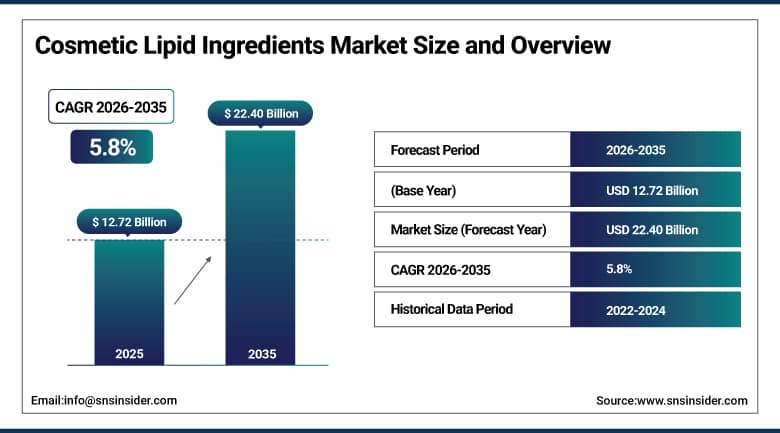
The Cosmetic Lipid Ingredients Market is projected to grow from USD 12.72 billion in 2025 to USD 22.40 billion by 2035, reflecting a compound annual growth rate (CAGR) of 5.8% from 2026 to 2035.
Read More
Recent developments indicate a shift towards commercialization of biotechnology-derived ceramides and phospholipids, which are replacing traditional lipids from plant and animal sources in premium skin care formulations. The demand for ceramides has doubled over the past five years due to increased consumer education regarding skin barrier technologies and dermatological claims. Fermentation methods are also seen as more sustainable and efficient compared to traditional extraction techniques.
In January 2026, Croda International acquired niche bio-fermentation technology assets aimed at increasing production of high-purity ceramides for premium cosmetics. This acquisition follows Croda's 2023 purchase of Solus Biotech, highlighting an industry trend where major suppliers consolidate their biotechnology-derived lipid production capabilities.
Market trends show that biotechnology-derived ceramides are increasingly favored over animal-derived lipids in barrier-repair formulations. The focus on clean label and vegan products is shifting demand towards plant-oil-derived emollients. Additionally, manufacturers are launching multifunctional lipid actives that combine barrier repair, anti-aging, and calming effects.
In the U.S., the Cosmetic Lipid Ingredients Market is projected to grow from USD 3.15 billion in 2025 to USD 5.30 billion by 2035, with a CAGR of 5.4%. This growth is supported by a robust local skin care sector that mandates the use of lipid active ingredients like ceramides and phospholipids based on their efficacy in barrier function. Social media and dermatological recommendations are driving consumer demand for premium lipid-based products.
Regional insights reveal North America dominates the market with 77% share in 2025, followed by Europe at 26% led by Germany. The Asia Pacific region, with China and India at the forefront, is the fastest-growing market, expected to see significant growth rates of 10.45% and 11.45% CAGR, respectively, due to expanding domestic cosmetics manufacturing and increasing premium skin care consumption.
In terms of market segments, plant-based sources held 52.7% share in 2025, while synthetic/biotech-derived lipids were the fastest-growing segment. Fatty acids and esters represented 34.6% of the market, with ceramides showing growth rates of 10.2%. Skin care applications accounted for 48.3% of the market, while sun care is emerging as the fastest-growing segment with a CAGR of 7.4%.
As the Cosmetic Lipid Ingredients Market evolves, the demand for scientifically validated products that repair and strengthen the skin's lipid barrier is expected to continue driving growth in the sector.