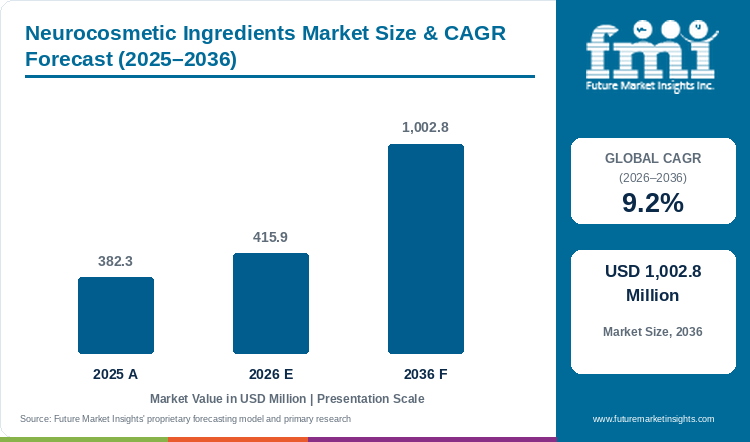
The neurocosmetic ingredients market is projected to grow from an estimated USD 415.9 million in 2026 to USD 1,002.8 million by 2036, reflecting a compound annual growth rate (CAGR) of 9.2% over the decade. The market was valued at USD 382.3 million in 2025, indicating significant growth potential due to rising consumer demand for products that offer stress relief, mood enhancement, and anti-aging benefits.
Read More
Brand owners are increasingly incorporating calming and mood-enhancing claims into their products, including serums and creams, requiring neuro-active ingredients supported by clinical data. In March 2026, Givaudan Active Beauty introduced PrimalHyal NeuroYouth, backed by clinical studies involving over 120 volunteers. Similarly, dsm-firmenich launched Alpaflor Neurosooth, which reportedly reduced stress-induced redness by 34% compared to a placebo after two months.
According to Future Market Insights (FMI), neuropeptides, which are projected to command a market share of 33.5% in 2026, are favored by skincare brands for their long clinical history supporting their effectiveness against expression lines. The anti-aging segment accounts for 37% of market sales, while facial skincare is expected to represent 57% of application sales in 2026. As consumer interest in mood-enhancing formulations increases, expansion in body care products is anticipated.
The fastest-growing region for this market is South Korea, with a projected CAGR of 10.1% from 2026 to 2036, reflecting the global influence of K-beauty brands. Brazil and the USA are also expected to experience substantial growth at 9.7% and 9%, respectively, while the UK is expected to grow at the slowest rate of 8.4% during the same period.
The rising prevalence of consumer stress is driving demand for neurocosmetic products. An American Psychological Association poll conducted in November 2025 indicated that 75% of surveyed U.S. adults felt more stressed about the country’s future than before, further signaling an opportunity for skincare brands to leverage neuro-active ingredients in their formulations. However, regulatory compliance, particularly in the EU and Greater Britain, presents challenges as each claim requires demonstrable evidence, increasing testing costs.
Key players in the neurocosmetic ingredients market include Givaudan, Croda, dsm-firmenich, Symrise, IFF, Clariant, Lubrizol, Eurofragance, and SkinBioTherapeutics. These companies are expected to continue expanding their neuro-active ingredient offerings through innovations and acquisitions in response to market demand.