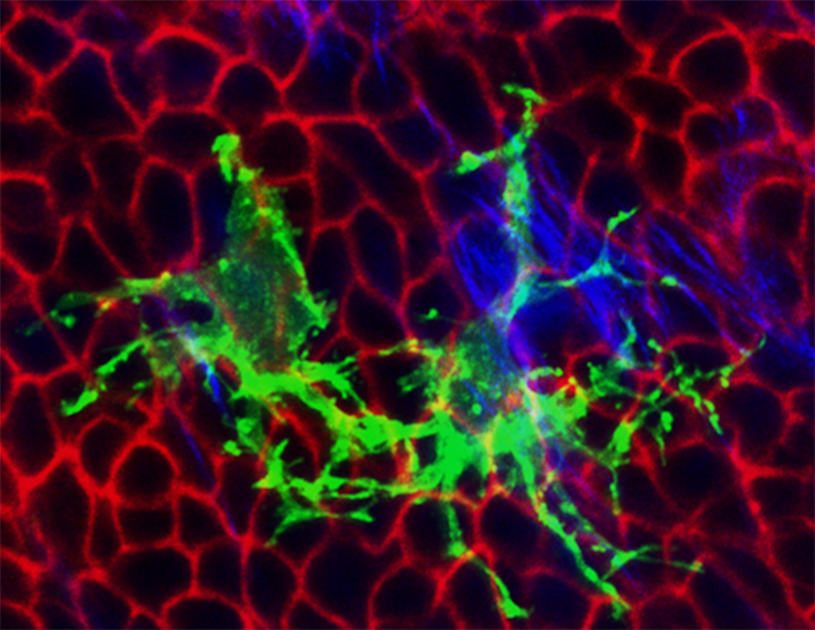
A recent study published in the Journal of Cell Biology by researchers from Yale School of Medicine challenges long-held beliefs regarding fibroblasts, the supportive cells in the skin. The study found that skin can remain resilient even with a significant reduction of fibroblasts, specifically when 60 to 70% of these cells were eliminated in mice.
Read More
Traditionally, fibroblasts have been considered essential for the skin's regenerative processes, as they secrete growth-promoting molecules and contribute to tissue structure. However, this study observed that skin stem cells continued to divide at normal rates even in the absence of a considerable number of fibroblasts. Co-first author Isabella Gaeta, a postdoctoral researcher at YSM, expected a decrease in stem cell activity, stating, “We hypothesized that this would cut down a lot of the stem cell growth. But that’s not what happened.”
The research was conducted in the lab of Valentina Greco and in collaboration with Sara Wickström from the Max Planck Institute for Molecular Biomedicine. Previous assumptions about fibroblasts' critical role stem from experiments in culture dishes, which do not accurately represent what occurs in living organisms. To investigate, the team used a genetic mouse model to selectively deplete fibroblasts and monitored the stem cells’ behavior.
Using two methods to track cell division, researchers found that the number of dividing stem cells remained consistent in both fibroblast-depleted mice and control groups. This pattern persisted in both adult and newborn mice, even as the latter were expected to need more fibroblast support during rapid growth phases.
Despite the resilience observed, the study noted subtle changes, such as a softer basement membrane, which suggests fibroblasts play a role in finer mechanical properties of the skin. The remaining fibroblasts appeared to adapt, with larger nuclei indicating potential stress as they compensated for the lost cells.
Gaeta emphasized that fibroblasts are still vital, stating, “They are very important, and so much so that we suspect the few that are left will actually try to make up for the loss of their neighbors.” This research indicates a complex network of fibroblasts that may not only support skin regeneration but also maintain its barrier functions.
The study raised important questions about fibroblast functions under stress conditions, such as wounds, which could provide insight into why aging skin tends to heal more slowly. The researchers aim to further explore the compensatory mechanisms of fibroblasts and their molecular changes following depletion.
This research has received support from the National Institutes of Health and other organizations, underscoring the collaborative nature of the study.