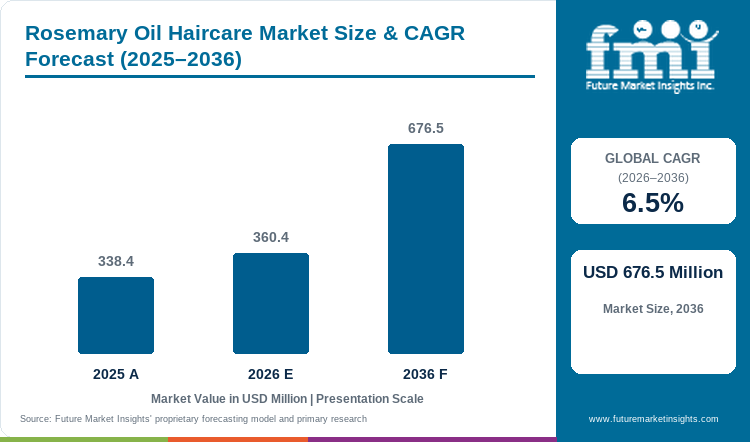
The Rosemary Oil Haircare Market is projected to grow from USD 360.4 million in 2026 to USD 676.5 million by 2036, reflecting a compound annual growth rate (CAGR) of 6.5%. Sales of rosemary oil haircare products are anticipated to increase steadily, transitioning from USD 338.4 million in 2025 to USD 360.4 million in 2026, before reaching USD 676.5 million in 2036. Consumers are increasingly integrating rosemary-based products into their haircare routines, utilizing them alongside scalp-care and hair-growth treatments.
Read More
In July 2025, L'Oréal noted that their consumer haircare segment experienced double-digit growth following the introduction of new products, including Growth Booster. This trend indicates that treatment-oriented rosemary oil products will have to compete with established hair-loss solutions in mainstream retail channels. The success of these products will depend on the strength of their claims and their ability to demonstrate effective performance.
Country-specific regulations will significantly influence the distribution of these products from their initial digital discovery to retail shelf placement. Data from the FDA shows 1,298,361 active cosmetic product listings and 16,398 facility registrations in the U.S. as of June 30, 2026. Although these figures do not represent FDA approval, they are crucial for market access under the Modernization of Cosmetic Regulation Act (MoCRA). Countries such as South Korea and Japan demand separate review processes for products making stronger hair-loss claims, necessitating tailored strategies for each market.
Key insights from the market analysis indicate that controlled dosing methods are elevating rosemary oil from casual oil mixing into habitual cleansing and leave-in routines. In terms of product type, classic lines are expected to make up 36.0% of the market share in 2026, while conventional formulations are projected to account for 55.0% of the market due to their effective preservation and user experience. Liquid and serum formats are forecasted to dominate at 28.0% market share, benefiting from precise scalp application.
Some notable companies in the rosemary oil haircare sector include Procter & Gamble, Unilever, L'Oréal, Olaplex, and Amorepacific. Analyst Rahul Pandita noted that brands succeed when the application remains straightforward and claims can be substantiated for cosmetic use, emphasizing that premium pricing can be undermined if safety or regulatory compliance is compromised.
The market is segmented by product type, nature, format, price positioning, sales channel, and region. In 2026, e-commerce and direct-to-consumer sales channels are expected to account for 35.0% of market share, shaped by digital education and ease of reorder.
Growth rates in various countries reflect differing consumer dynamics, with South Korea leading at a CAGR of 7.8%, followed by Saudi Arabia at 7.5% and the UAE at 7.1%. In contrast, the U.S. market is projected to grow at a CAGR of 6.8%, indicating a competitive landscape for rosemary oil haircare products in both retail and digital environments.