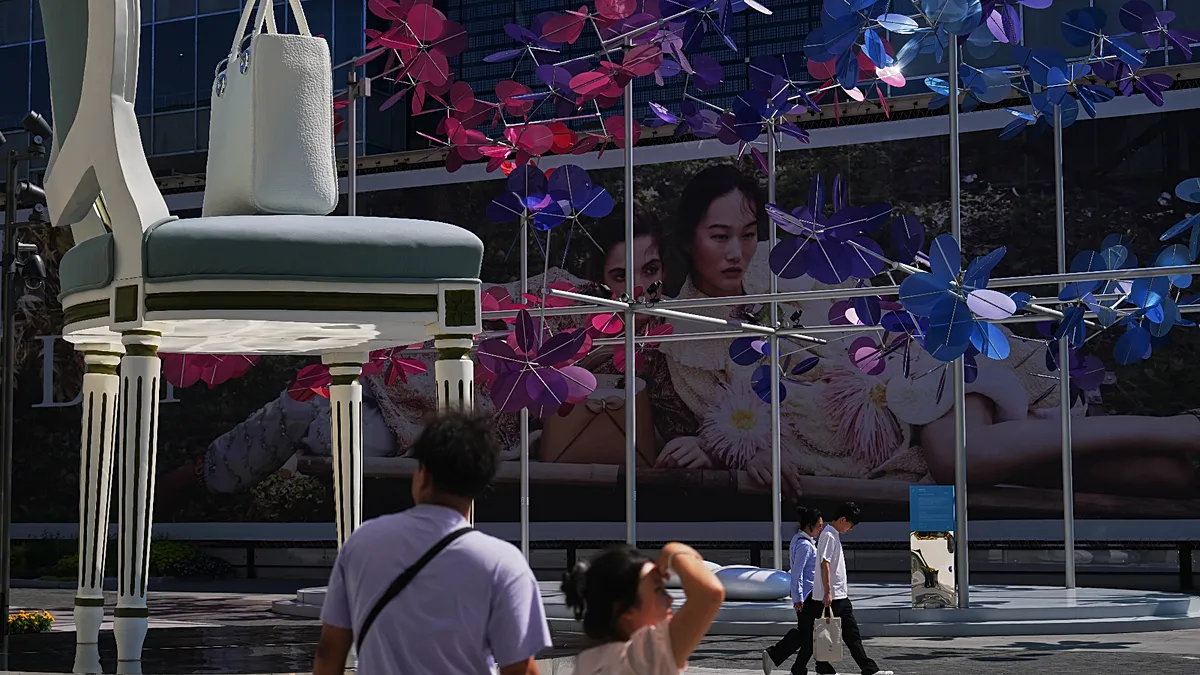
Chinese consumers are shifting their focus from spending more on luxury items to seeking better deals, which is impacting European luxury brands. This change in consumer behavior coincides with a slowdown in China's economy, which grew 4.5% year-on-year in the third quarter but continues to face weak domestic demand.
Read More
Once responsible for about a third of global luxury spending, Chinese consumers have become cautious buyers, significantly affecting revenues for companies like LVMH and Hermès. LVMH recently reported a decline in organic sales for its fashion and leather goods sector, citing decreased demand in China.
In response to changing consumer habits, luxury firms are adapting their strategies. Louis Vuitton has closed five stores in mainland China over the last two years, while Galeries Lafayette shuttered its Beijing flagship in May. Consumers are increasingly turning to the second-hand market or opting for local brands instead.
The personal luxury goods market in mainland China contracted by 3–5% in 2025 following an 18–20% plunge in 2024. In contrast, the second-hand luxury market expanded by 15–20%, according to Bain & Company. The total second-hand luxury sales in China reached 38.4 billion yuan (€5.1 billion) in 2025 and are projected to exceed 100 billion yuan (€13.3 billion) by 2030, as noted by Insight & Info Consulting.
At a new second-hand store in Shanghai, customers must wear gloves to handle luxury items. Phoebe Ma, a shopper, shared that her mother’s generation associated luxury brands like Louis Vuitton with prestige, whereas younger consumers now prefer trendy brands over traditional luxury monograms.
Bank of America’s Chen Luo indicated that luxury spending is evolving, with consumers valuing self-identity and cultural relevance over mere status. He also pointed out the unique digital-driven retail landscape in China, suggesting that foreign brands must strive to remain relevant.
Furthermore, tensions such as cultural and legal disputes pose additional challenges for Western brands. Louis Vuitton recently won a trademark case against a Chinese beverage chain, which faced criticism online. Shopper Echo Wang remarked that the public backlash indicated a disconnect between brand perceptions and local sentiment.
Despite these challenges, analysts maintain that China remains a crucial market for the global luxury sector, though not expected to be a significant growth driver in the next few years. Luxury spending typically aligns with economic recovery, benefiting affluent consumers first.